
Tinley Park Resident Lookup Sources
No agency keeps a public master list of everyone in Tinley Park. The search instead joins records that name people in distinct roles. Start with the question. A parcel card can tie a tax-associated name to an address. A docket can prove that a named party appears in a case. A vital index can point toward a life event, while access to the certificate itself stays controlled. The city-county split matters at each step: a Tinley Park event may belong with Cook County or Will County.
| Record | What It Confirms | Where to Search | Access |
|---|---|---|---|
| Property roll | An owner or taxpayer role, parcel, and mailing details | Cook Assessor or Will Supervisor of Assessments | Free web search; copies vary |
| Voter registration | Regulated registration status and election geography | Illinois voter lookup and county election office | Limited by 10 ILCS 5/1A-25 |
| Court index | Party role, case number, dates, type, and status | Cook Odyssey or Will Public Access | Free summaries; fuller files onsite |
| Vital records | Birth, death, or marriage event leads | Cook or Will clerk, local registrar, IDPH | Indexes vary; copies restricted |
| Public role filings | Licensee, entity officer, agent, or business role | IDFPR and Illinois Secretary of State | Free public lookups |
| Unclaimed property | A possible property match tied to search terms | Illinois I-CASH | Free search; proof needed to claim |
Use the narrowest official source first. For a full name alone, search court, business, or license roles, then seek a date or place in the library's news and yearbook collections. For an exact address, use the county parcel system and keep the owner label separate from occupancy. For a death or family link, begin with an obituary, cemetery item, or death-index lead, then move to probate and the proper vital custodian. Record the exact spelling and role shown. Those details keep a Tinley Park resident lookup from turning a same-name lead into a false match.
Cook Court Names and Cases
The Cook County Odyssey search accepts a party name or case number. Its official user guide says to enter names as last name, first name. Wildcards work with at least one first-name character, three last-name characters, or four case-number characters. Filters include party type, location, search type, filing dates, case status, and judicial officer. Search types extend beyond a plain party name to business, attorney, citation, cross-reference, and nickname fields.
Results normally show case number, defendant, filing date, case type, and status, with up to six columns. A search returns no more than 200 rows. The detail view may show a summary, hearings, events, and dispositions. A disposition is the court's recorded outcome for an event or case. Only the first 50 events appear until the user asks for more. Cook warns that web data are brief summaries, may lag, and are not the official file. Use a courthouse terminal or request the file when the distinction matters.
For a Tinley Park name search, save the party role as well as the name. A defendant, plaintiff, attorney, and company are not interchangeable. Keep the case number and filing date as the two best join keys.
Will Court Access for Residents
The Will County Circuit Clerk Public Access begins with an agreement screen. Its observed categories include probate, guardianship, family, law, small claims, traffic, tax, criminal, orders of protection, and expungement or sealing. The exact name fields after agreement were not available in the research capture, so they should not be guessed. The portal itself also says that the web search is not the official record.
The public counter and terminals at the Circuit Clerk, 100 W Jefferson Street in Joliet, can show document images or fuller file material not shown online. Physical files and copy requests are another route, and the clerk lists i2File for copies. Call 815-727-8592 before traveling to confirm access and case-specific cost. The captured agreement screen below shows the category route and the limit between online index data and courthouse material.
View the Will County public-access agreement and case categories.
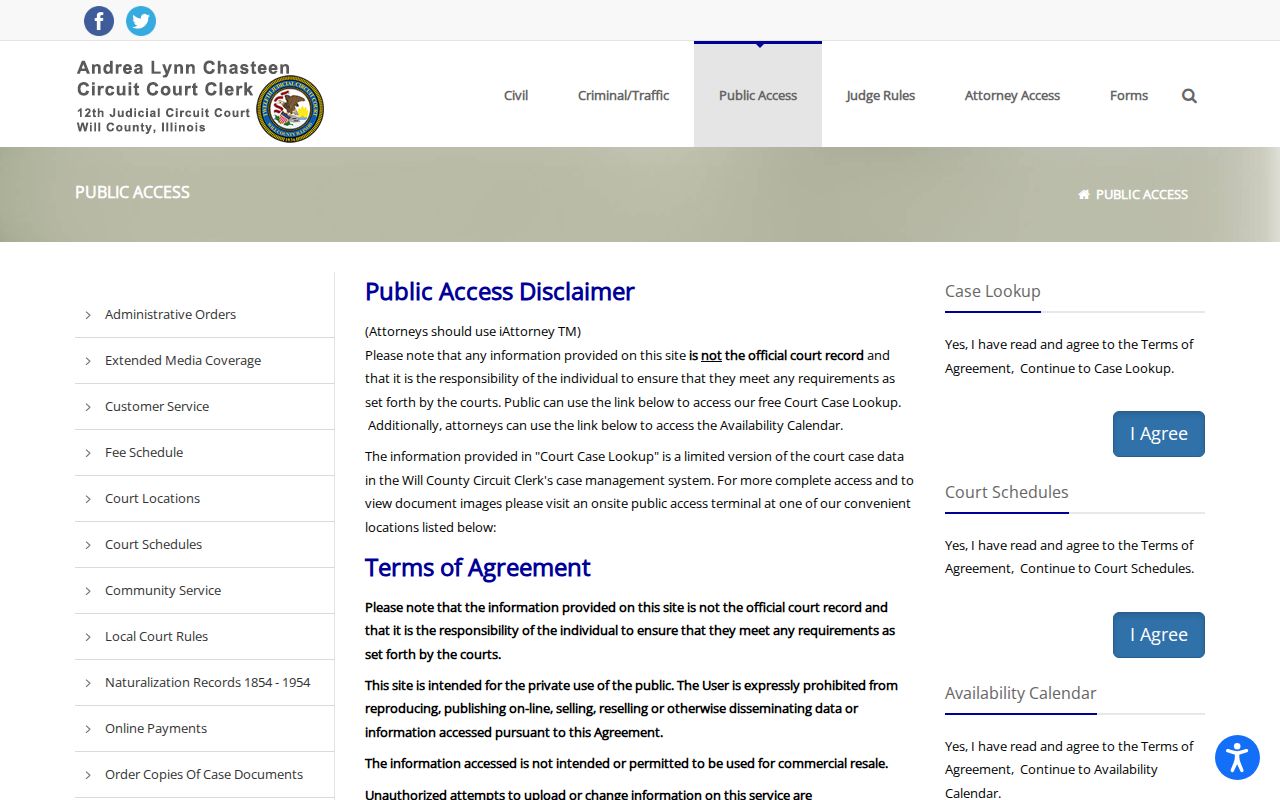
The screen is a route into the index, not proof about any resident. Preserve the category, case number, party role, and date after the search opens.
Verify Tinley Park Resident Records
A strong match keeps source roles intact. Do not call an assessor owner an occupant, or turn a directory subscriber into the whole household. Spellings, initials, suffixes, maiden names, and date ranges should remain in separate notes. Then run a second official source whose fields do not merely repeat the first. This method is slower than accepting the first name hit, but it sharply cuts the risk of attaching the wrong court, parcel, or family record to someone.
- Fix the county first. Match the Tinley Park address to Cook or Will, then save the exact address, township, parcel number, owner or taxpayer label, and capture date.
- Search the proper court index with the source spelling and name variants. Save the case number, party role, filing date, type, status, and portal warning.
- Cross-check a separate fact. A lawful date, relative, school year, license number, deed number, obituary, or vital-index lead can distinguish two people with the same name.
- Request the underlying file or certified copy from its custodian when proof is needed. An index row is a locator, not the filed image or certified record.
- Docket
- The court's dated list of filings, hearings, and actions in a case.
- Index vs image
- An index points to a record with brief fields; an image reproduces the filed page and may require a fee or office visit.
- Certified copy
- A custodian-issued copy marked as an official reproduction of the record.
- PIN
- The county parcel identification number, a property key rather than a person identifier.
Vital records add another layer, but access depends on the record. Illinois births are not open public certificates. IDPH's genealogy route currently covers births at least 75 years old and deaths more than 20 years old but not before 1916. Cook offers older marriage genealogy copies under its stated threshold, while the Illinois Vital Records Act sets different archive-inspection ages. Always distinguish an index lead, a genealogy copy, an archive reproduction, and a certified copy.
I-CASH Adds a Tinley Park Lead
The Illinois Treasurer's I-CASH search offers a useful comparison source when the question involves unclaimed property. The form accepts a last or business name, first name, city, ZIP code, and property ID. A result is only a possible match. The claim process asks for proof of identity or relationship, so neither a city nor ZIP hit proves present residence.
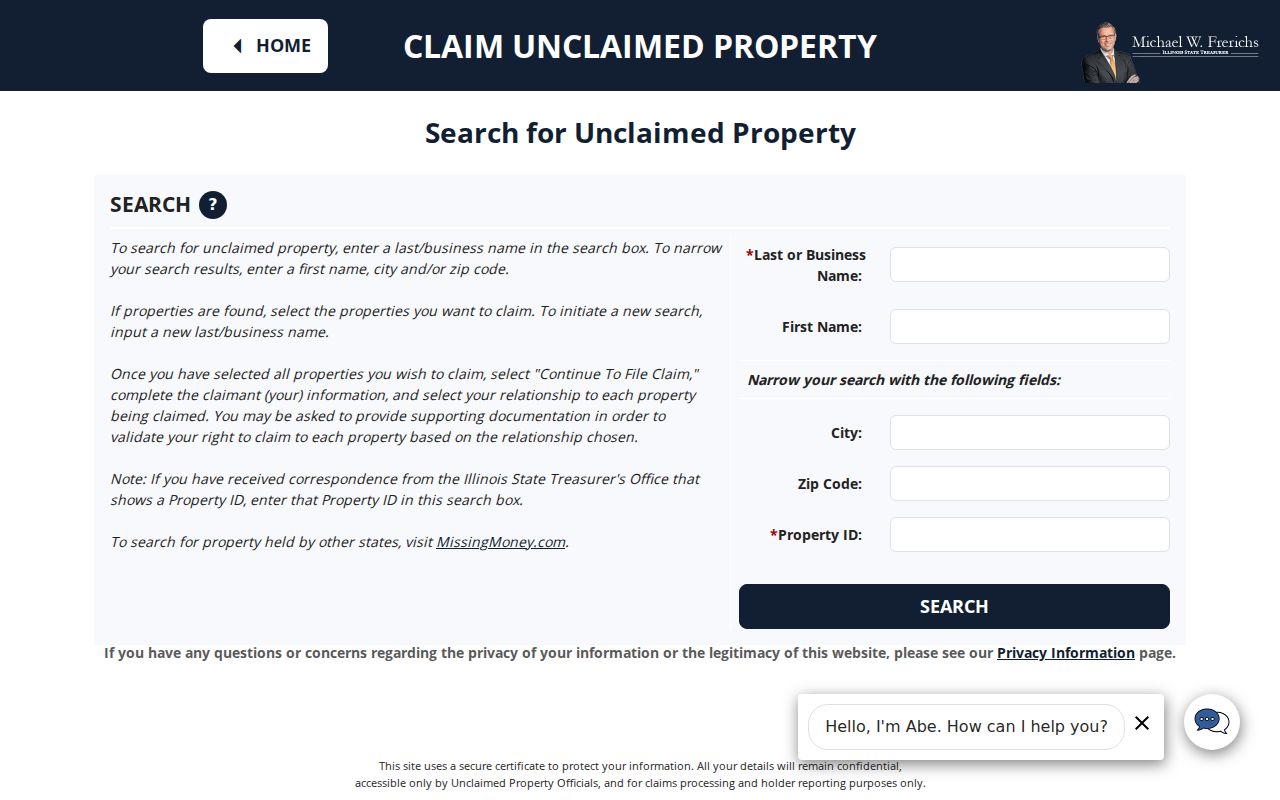
The captured fields show why a city or ZIP should narrow a name search, not settle identity. Keep the property ID and claim status with any note drawn from the result.
This source works best beside a dated court, obituary, parcel, or license record. It should not be used to infer an address that the Treasurer does not display. That restraint is part of reliable name research.
Tinley Park Public Role Lookups
Business and license searches can confirm a public role. The Illinois Secretary of State entity search supports business name, registered agent, president, secretary, manager, file number, keyword, and partial-word modes. The IDFPR License Lookup covers individuals and entities across its regulated divisions. Save the role, record number, status, dates, and public business address exactly as displayed.
A registered office or work site is not a home. That common mix-up is the assessor myth in another form: an owner, taxpayer, permit applicant, directory subscriber, or public officer may be tied to a record without living at its address. Use these filings to distinguish same-name candidates or confirm a known public role. Do not convert them into a claim about where a person sleeps.
Which result is strongest? A source-specific number plus a date and a second matching fact beats a bare name. If two candidates remain, mark the Tinley Park resident lookup unresolved.
Tinley Park Family Record Routes
A family search should use the channel built for that record. Begin an heir question with a death lead from a public obituary, cemetery item, funeral notice, or death index. Then search Cook or Will probate for the decedent's case number, filing date, executor or administrator, and any public real-property reference. A probate file may name relatives, but sealed pages, minors' details, and old addresses remain limits.
Adoption connections follow a private process. The Illinois Adoption Registry and Medical Information Exchange uses consent, identification, and an application route for people connected to an adoption. The DCFS adoption-records route describes eligibility and a court-approved Confidential Intermediary search. Neither is a public birth-family directory. A voter result, directory listing, or birth-certificate request cannot be used to bypass those safeguards.
For less restricted family history, Tinley Park Public Library can help with newspapers, yearbooks, Bell directories, HeritageHub, and its local-history index. Ask for a title, year, or page image and then corroborate the name with another dated source.
Tinley Park Resident Lookup Limits
Illinois law opens some indexes while closing or redacting sensitive fields. Under 10 ILCS 5/1A-25, the voter file omits such details as birth date, phone, Social Security number, and identifiable email, and public street numbers are redacted. The list is regulated and is not a household directory. An absent result may reflect a county mismatch, spelling change, inactive record, or protected address.
The Illinois Address Confidentiality Program gives eligible participants a substitute address for new government interactions. It cannot erase older public records and cannot promise that property records will be hidden. Do not use a failed match to expose or reconstruct an address. Correct an error with the office that holds the source record; changing a commercial listing does not alter a court, parcel, or vital file.
Lawful use. A Tinley Park resident lookup is for lawful personal research. Never use a record to stalk, threaten, harass, or intimidate anyone.